Nowadays, the development of the digital economy undermines our traditional thoughts about how businesses and services are improved. The whole society is driven by the capability to collect, utilize and analyze a large amount of machine-readable information. These digital data show how corporations interact, and how customers gain services, information, and products. So, what is the digital economy? It refers to a wide range of economic activities that use digitized information and knowledge collected by the internet, big data, cloud computing, and other high-tech ways.
The public relations (PR) are gradually influenced by the rapid changes in internet technology. The emergence of a social platform such as YouTube, Facebook and Twitter has drawn the amount of attention from PR practitioners. Internet applications have become the latest channel for PR. Meanwhile, internet applications are used as a tool to communicate with various stakeholders. In the digital economy era, PR practitioners have changed their communication way. They utilize social media to enhance relationships with stakeholders.
This video shows how YouTube provides information to PR.
Using social platform have more benefits in the PR industry. As we all know, the characteristics of social media are promoting everyone to express their opinions and share the experience. On the one hand, during the widespread use of social media, the increasing people would engage in, it could cultivate the greater interactive capacity of PR. On the other hand, online platform could help companies to build brand awareness and reputation. About 74% of customers would refer to the online shared experience and almost 70% of consumers would compare different brands before they choose products and services. PR could cooperate with online celebrities on different platforms to publicize. Positive feedbacks could support the improvement of the company brand and reputation. Meanwhile, PR could feedback on negative reviews in time by using the social media platform.
Social media as a tool for building relationships, its potential for expanding engagement and strengthening brand awareness and reputation could make a natural fit for PR. The 2019 Global Communication Report predicts which platform is the most important in the next 5 years to improve communication.
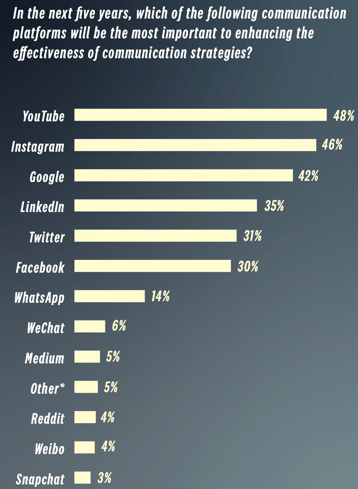
Due to the popularity of social media, communication avenues are increased and developed into various functions. Then customers could access them according to their various requirements and situation. It requires practitioners to maintain relationships with a wide range of stakeholders, in order to be successful in the modern PR industry. Besides consumers, there are a large number of influencers in each channel such as bloggers and consumer enthusiasts with whom corporations need to engage in instant conversation. Meanwhile, when PR considers programs, they are likely to negotiate with financial analysists, shareholders and other stakeholders.
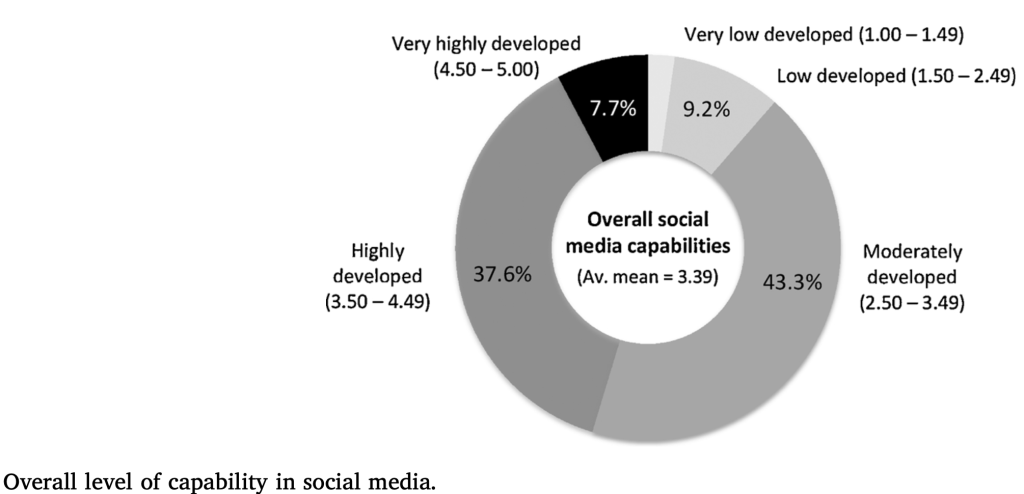
Compared with previous practitioners, PR employees in the current digital economy situation have experienced many changes, they need to adapt to social media and learn to engage with varied stakeholders. The digital technology is reshaping PR industry rapidly, and it also put forward higher requirements for PR practitioners. Although the importance of online platform is recognized, the large part of PR practitioners still maintains the low to modest abilities in practice. This phenomenon presents a challenge for PR employers due to practitioners fail to adapt to improve their capabilities and prepare for the future.
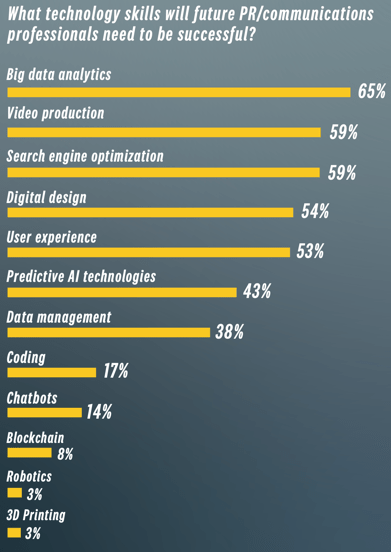
In the future, employees need to be flexible workers with transferable skills. Besides, we should expect to cultivate lifelong learning skills to adapt to the rapidly changing world. The 2019 Global Communication Report predicts these technology skills would be necessary for the future.
The increasing aging population is the big trend that the whole world is facing. In this stage, most of the PR programs target young people, especially on social media. However, the older generation has spare time and economic power. Therefore, how to use digital technology to introduce products and services for aging individuals would be a significant issue in the future for PR.
With the popularization of the network, the use of social media is becoming increasingly common. The majority of aged people begin to use it. At the end of 2016, about 62% of adults over 65-year-old have used Facebook. It is interesting that the increase from 48% to 62% only costs one year. PR practitioners should note the significant role of older internet users in a digital platform in the future. They could collect data from social media, search engines, databases, and other online platforms by using age as a variable.
In summary, PR practitioners have changed the way they communicate, they gradually rely on different social media. It requires them to engage with various stakeholders. In the future, the PR industry needs to focus on cultivating professional employees with transferable skills. Moreover, as the aging population is a big trend in worldwide, the PR industry is required to consider how to serve these potential customers.
References
Allagui, I., & Breslow, H. (2016). Social media for public relations: Lessons from four effective cases. Public Relations Review, 42(1), 20-30.
ASEAN-India Center. (2018, October 11). Understanding the Digital Economy: What Is It and How Can It. Retrieved February 13, 2020, from https://www.adb.org/news/events/understanding-digital-economy-what-it-and-how-can-it-transform-asia
Capozzi, L., & Zipfel, L. B. (2012). The conversation age: the opportunity for public relations. Corporate Communications: An International Journal, 17(3), 336-349.
EMR. (2019, April 30). Challenges PR and communications face in 2019 – and how to overcome them. Retrieved February 13, 2020, from https://www.emrrecruitment.co.uk/blogs/challenges-pr-and-communications-face-in-2019-and-how-to-overcome-them-91203015301
Huang, Y. H. C., Wu, F., & Huang, Q. (2017). Does research on digital public relations indicate a paradigm shift? An analysis and critique of recent trends. Telematics and informatics, 34(7), 1364-1376.
Macnamara, J., Zerfass, A., Adi, A., & Lwin, M. O. (2018). Capabilities of PR professionals for key activities lag: Asia-Pacific study shows theory and practice gaps. Public Relations Review, 44(5), 704-716.
Nunan, D., & Di Domenico, M. (2019). Older Consumers, Digital Marketing, and Public Policy: A Review and Research Agenda. Journal of Public Policy & Marketing, 38(4), 469-483.
UNCTAD. (2019). Digital Economy Report 2019: Value creation and capture–Implications for developing countries.
USC ANNENBERG CENTER. (2019). 2019 GLOBAL COMMUNICATIONS REPORT:THE FUTURE OF TECHNOLOGY IN COMMUNICATION. Retrieved from http://assets.uscannenberg.org/docs/2019-global-communications-report.pdf
Wolf, K., & Archer, C. (2018). Public relations at the crossroads. Journal of Communication Management.
 Qimeng Zhao's Blog