There are 11 topics provided during this model. And I am interested in the circular economy in week 5 and smart cities in week 9. I suppose the key factor in the circular economy is sustainability. A large number of companies have integrated the concept of the circular economy into its design to minimize the impact on the environment. For example, Huawei selects harmless and more recycled materials and promotes lightweight designs in raw material acquisition. From product use perspective, extending product lifespan and make products easier to upgrade and repair. At the end of the lifecycle, products are easy to disassemble and recycled by different categories separately.
Urbanization promotes the improvement of civilization, economy, and technology. However, a large number of urban populations would put pressure on natural and social resources and living costs. To cope with these challenges, smart city projects are being built. 5G, IoT, AI, and cloud as innovative technologies are gradually establishing safer and more efficient cities. For example, as the Winner of the 2018 World Smart City Award, Singapore launched its ‘Smart City 2015’ plan in 2006 and applied information and communications technology (ICT) to various aspects, such as digital media and entertainment, education and training, financial services, manufacturing and logistics, healthcare and bioscience, and eGovernment.
2. My participation.
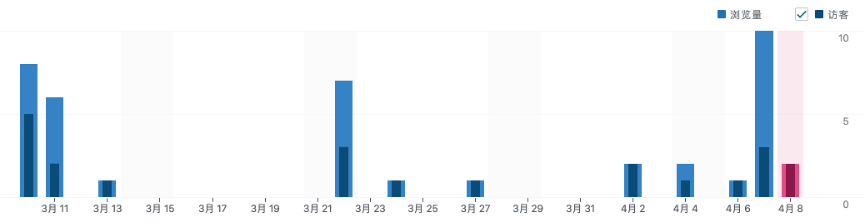
Thanks for this module, it pushes me to explore the new communication method, writing a blog. As a new blogger, the click rate is pretty low, I would post more interesting topics to attract more visitors in the future.
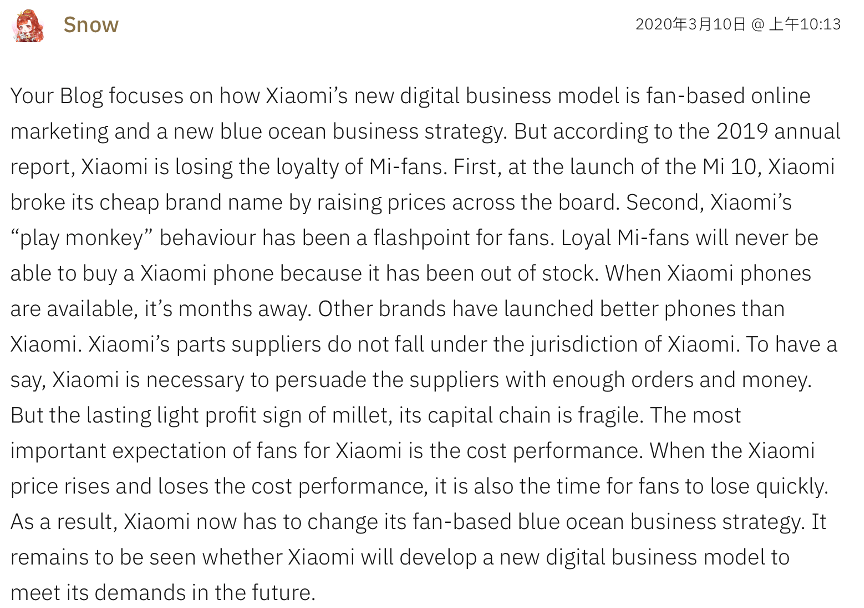
And the comment from others helps me to correct mistakes and expand related knowledge.
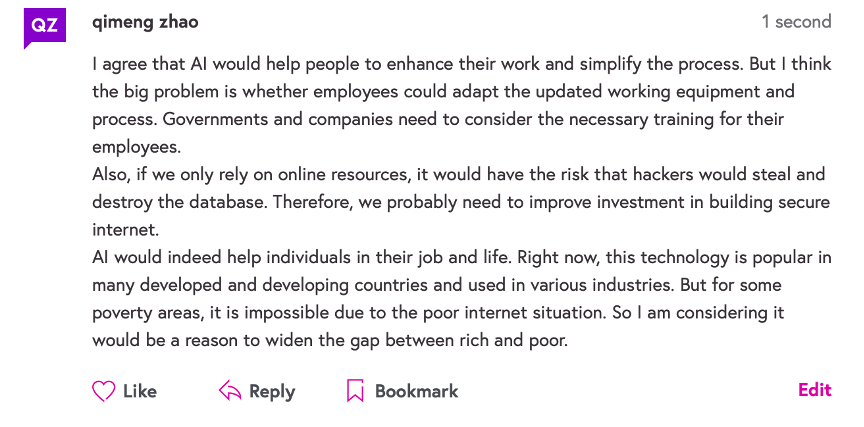
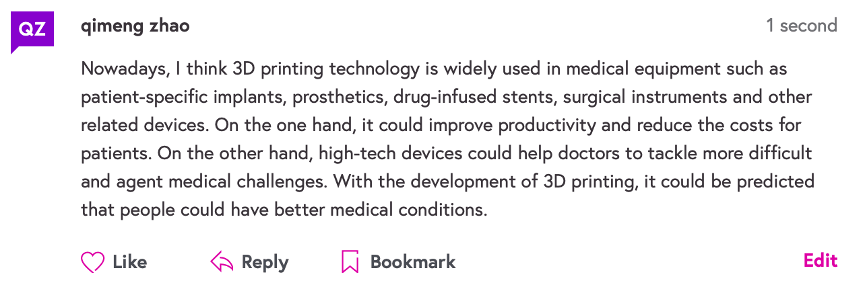
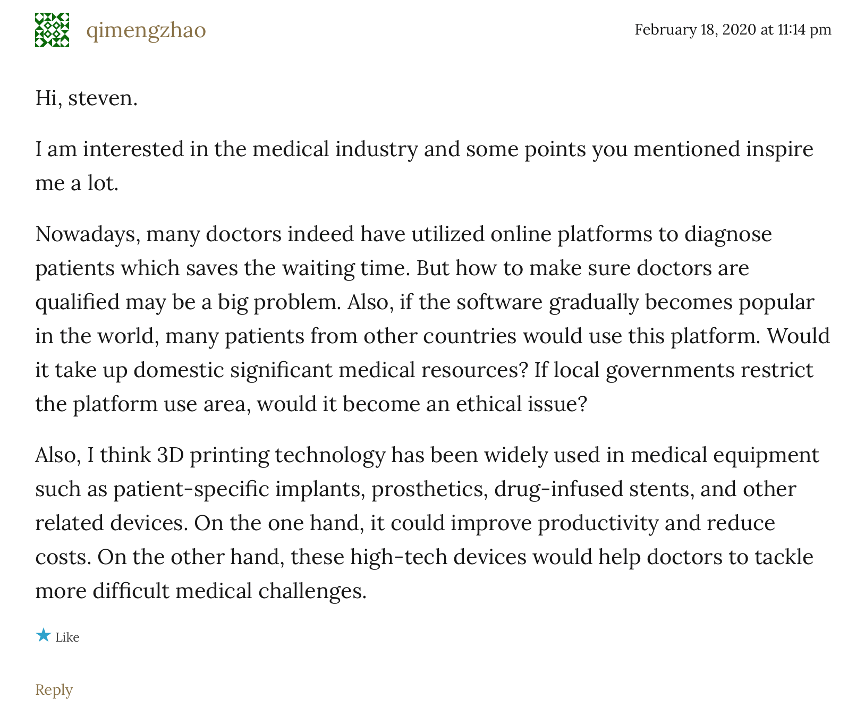
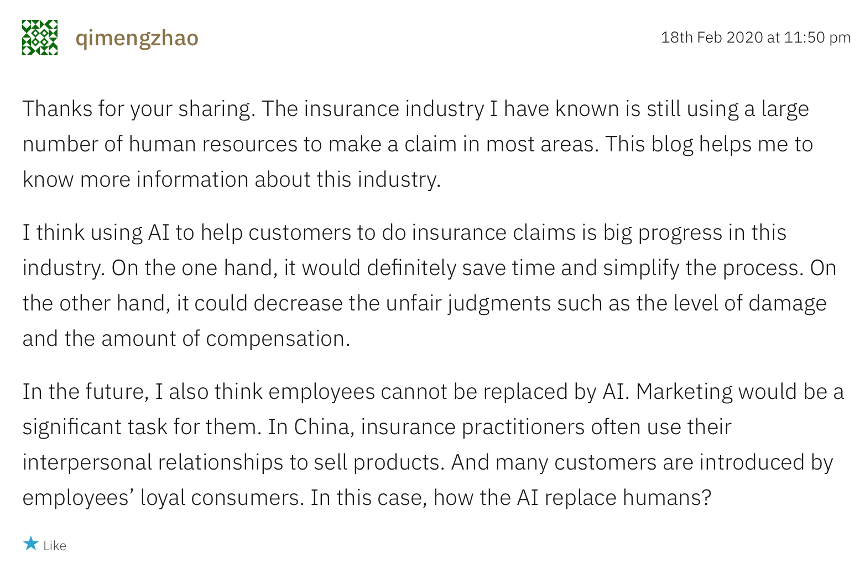
In MOOC, I put comments on AI and 3D printing topics and gain many useful thoughts from different perspectives.
AI would enhance human capability and performance in various industries. But I am considering the disadvantage AI would bring to human beings.
3D printing is significant to environmental sustainability because the printer merely puts it exactly where it is needed which saves materials. And my perspective is discussing the practical use in the medical equipment industry.
In my comments on blog post 2, I combined some views of MOOC and my personal experience to show my understanding of the challenges and opportunities about doctors and insurance managers in the future.
3. How this module influences my future-leaning and working.
This is my first time doing the online course, and I would talk about the improvement of personal abilities and actual skills from this video. The main points are:
Xiaomi Corporation was founded in April 2010. They use the “Smartphone + AIoT” strategy to support their main products smartphones, hardware, and other lifestyle products. Xiaomi’s unique fan-based marketing helps them to create a new e-commerce strategy called blue ocean business strategy.
“Smartphone + AIoT” strategy
Xiaomi uses IoT platform at the core to connect their smartphones and smart hardware. To create the commercial value, Xiaomi sell their phones and devices with affordable prices firstly. It is a good way to build a big marketplace for other connected products such as digital services and lifestyle products. Xiaomi notices its future in the IoT and organize an ecosystem of innovation around it.
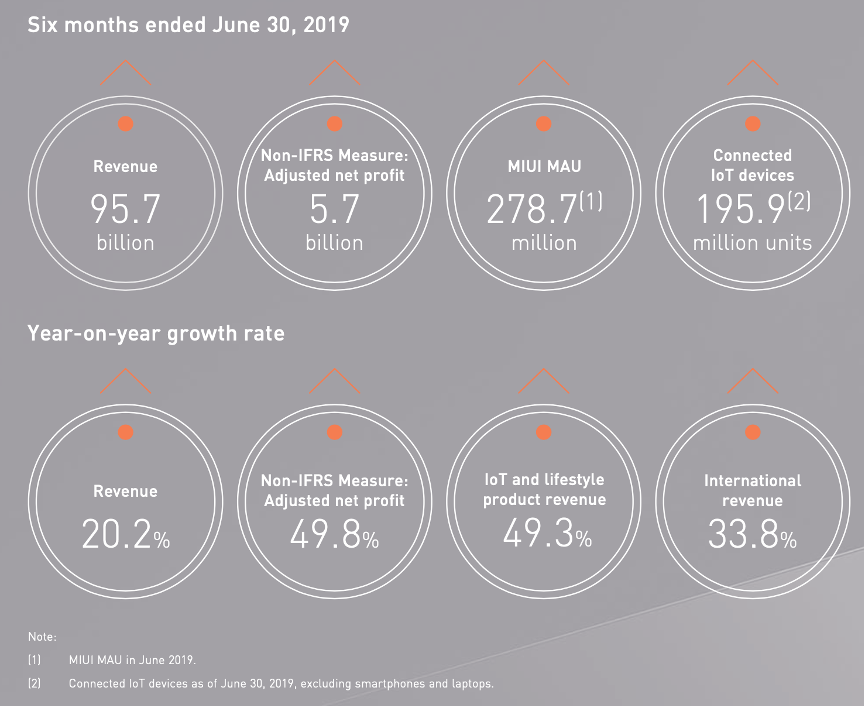
As of June 30, 2019, the number of connected IoT devices (excluding smartphones and laptops) on the Xiaomi loT platform was approximately 196 million units. The number of users who have five or more devices connected to Xiaomi’s IoT platform (excluding smartphones and laptops) increased to approximately 3 million, representing a year-over-year increase of 78.7%.
Xiaomi is committed to enhancing its AIot platform. On the one hand, it would provide enough investment to develop the open AloT platform to attract more third parties to participate in. On the other hand, the research and development department would build a comprehensive IoT ecosystem to strengthen the smart devices’ connection and user experiences.
Same as other internet companies, Xiaomi cannot provide all these various services. Therefore, it creates an ecosystem of third parties, which utilize Xiaomi’s brand, the marketplace, and venture capital. It has sold more than 800 different smart devices from 400 partners.
In Xiaomi’s third-party ecosystem, they build the creative collaboration with other brand manufacturers and consumers. Unlike other internet companies, Suppliers and customers could create new products with Xiaomi which is the biggest difference with other companies. For suppliers, Xiaomi would organize regular meetings to communicate with current operating conditions. For users, Xiaomi has an open attitude to learn suggestions through their fan club. This new model is called the business community’s ecological chain, which could let customers and related business partners to create products together.
Blue-ocean business strategy
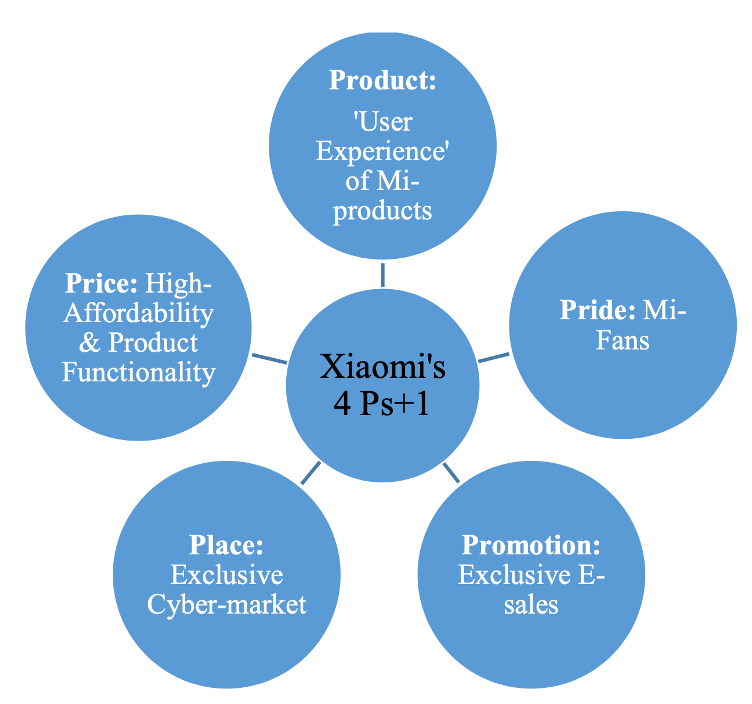
Online fan-based marketing is a new blue-ocean business strategy in digital business. The method is connecting the internet and marketing mix of 4Ps and proposing the fifth component pride. Xiaomi utilizes its fan club called ‘Mi-Fans’ and an online platform creates its 4Ps+1 paradigm.
One significant feature of Xiaomi’s product pays attention to user experience. Therefore, it creates a sociable internet environment which could help them to collect feedback to upgrade product instantly. In return, Xiaomi provides product updates weekly on the internet. Due to the cooperation between consumers and Xiaomi, their new products could catch the latest trend and promote customer-endorsed product development, it could improve establishing long-term business relationships between users.
2. Price
Xiaomi focuses on providing good quality products at a reasonable price. Although the performance of the smartphone is compatible with other competitors such as Samsung and Apple, their price only takes up one-third to one-half.
Xiaomi relies on cheaper online marketing. It would decrease from the mid-level operating costs such as employee expenses, shop rents and distributors’ and retailers’ commissions.
3. Place
The Internet provides a digital market without boundaries for consumers all over the world, where Xiaomi uses this environment to improve buyers’ involvement and build customer loyalty. By using the blue ocean strategy, Xiaomi’s engineers could communicate with their customers openly and collect feedback for products instantly.
4. Promotion
Compared with traditional marketing practices, Xiaomi has its unique online sales.
Products are launched with limited quantity within the limited time, this swift sale would boost customers’ desire and urgency to purchase what they like and then share their experience and recommend others via social media.
Meanwhile, by using online platforms such as Wei-Bo and We-Chat, Xiaomi could handle complaints, feedbacks, comments, and requests instantly. It would improve consumer engagement and enhance the relationships between Xiaomi.
Due to the good operation of social media, Xiaomi has cultivated a large number of customer base, who refer to themselves as ‘Mi-Fans’. With Xiaomi’s support, more than 600 million Mi-Fans share their user experiences.
5. Pride
Through blue ocean strategy, Mi-Fans and Xiaomi help each other in such a harmonious circle.
Xiaomi values its user bonding and community connection. Besides, it would help engineers to do product updates and improvements. It cultivates the ‘Mi-Fan family’ atmosphere by celebrating and creating the ‘Mi-Fan Festival’ for special buying events. These fans are proud to be who they are and of what they carry (Xiaomi smartphone), thanks to their strong sense of ‘belonging’ to Xiaomi.
As a Chinese disruptive innovative company, Xiaomi expands its product portfolio and improve user experience. It establishes a strong fan culture to boost their sales. Currently, Xiaomi is the world’s fourth-largest smartphone brand and has established the world’s largest consumer IoT platform.
References
Kuo, H. C., Luarn, P., & Chen, I. J. (2017). Value co-creation of Xiaomi in China. International Journal of Business and Economic Sciences Applied Research (IJBESAR), 11(1).
Yuan, X., & Li, X. (2019). The combination of different open innovations: a longitudinal case study. Chinese Management Studies.
Zhang, X., & Lu, W. (2019, November). Present Situation of Fans Economic Operation in China and the Example Analysis. In 2019 International Conference on Machine Learning, Big Data and Business Intelligence (MLBDBI) (pp. 261-265). IEEE.
Nowadays, the development of the digital economy undermines our traditional thoughts about how businesses and services are improved. The whole society is driven by the capability to collect, utilize and analyze a large amount of machine-readable information. These digital data show how corporations interact, and how customers gain services, information, and products. So, what is the digital economy? It refers to a wide range of economic activities that use digitized information and knowledge collected by the internet, big data, cloud computing, and other high-tech ways.
The public relations (PR) are gradually influenced by the rapid changes in internet technology. The emergence of a social platform such as YouTube, Facebook and Twitter has drawn the amount of attention from PR practitioners. Internet applications have become the latest channel for PR. Meanwhile, internet applications are used as a tool to communicate with various stakeholders. In the digital economy era, PR practitioners have changed their communication way. They utilize social media to enhance relationships with stakeholders.
This video shows how YouTube provides information to PR.
Using social platform have more benefits in the PR industry. As we all know, the characteristics of social media are promoting everyone to express their opinions and share the experience. On the one hand, during the widespread use of social media, the increasing people would engage in, it could cultivate the greater interactive capacity of PR. On the other hand, online platform could help companies to build brand awareness and reputation. About 74% of customers would refer to the online shared experience and almost 70% of consumers would compare different brands before they choose products and services. PR could cooperate with online celebrities on different platforms to publicize. Positive feedbacks could support the improvement of the company brand and reputation. Meanwhile, PR could feedback on negative reviews in time by using the social media platform.
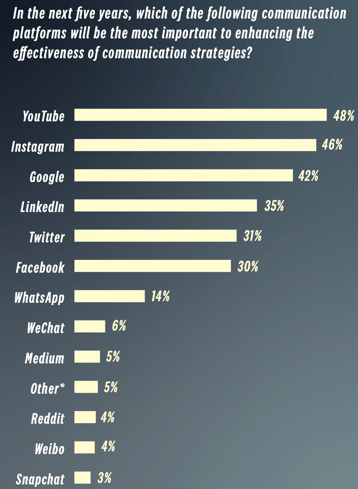
Social media as a tool for building relationships, its potential for expanding engagement and strengthening brand awareness and reputation could make a natural fit for PR. The 2019 Global Communication Report predicts which platform is the most important in the next 5 years to improve communication.
Due to the popularity of social media, communication avenues are increased and developed into various functions. Then customers could access them according to their various requirements and situation. It requires practitioners to maintain relationships with a wide range of stakeholders, in order to be successful in the modern PR industry. Besides consumers, there are a large number of influencers in each channel such as bloggers and consumer enthusiasts with whom corporations need to engage in instant conversation. Meanwhile, when PR considers programs, they are likely to negotiate with financial analysists, shareholders and other stakeholders.
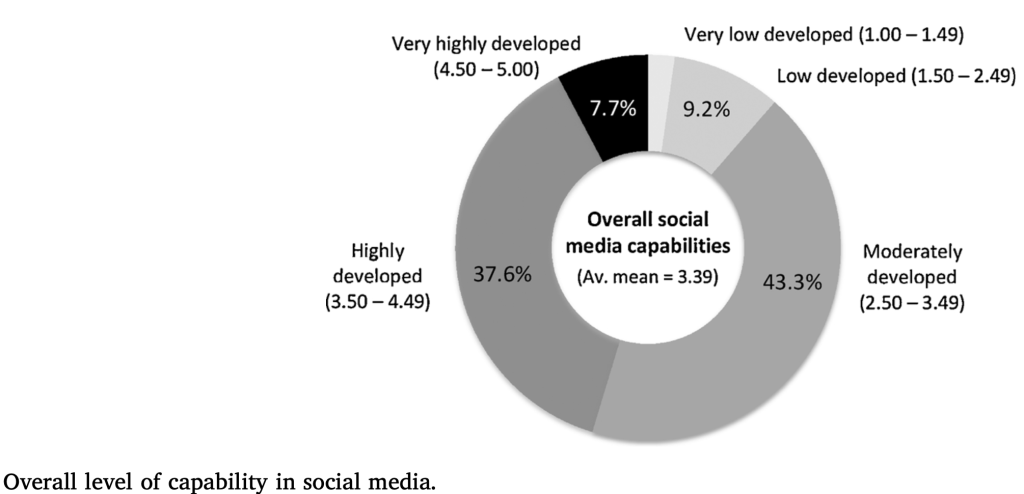
Compared with previous practitioners, PR employees in the current digital economy situation have experienced many changes, they need to adapt to social media and learn to engage with varied stakeholders. The digital technology is reshaping PR industry rapidly, and it also put forward higher requirements for PR practitioners. Although the importance of online platform is recognized, the large part of PR practitioners still maintains the low to modest abilities in practice. This phenomenon presents a challenge for PR employers due to practitioners fail to adapt to improve their capabilities and prepare for the future.
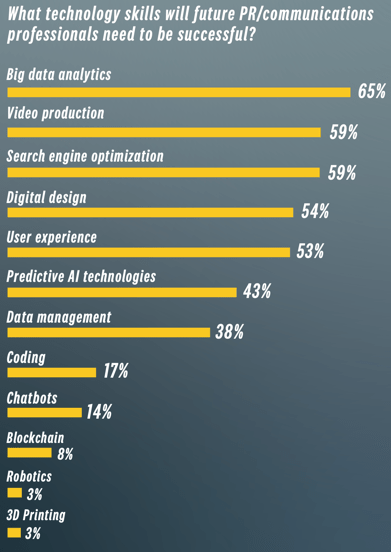
In the future, employees need to be flexible workers with transferable skills. Besides, we should expect to cultivate lifelong learning skills to adapt to the rapidly changing world. The 2019 Global Communication Reportpredicts these technology skills would be necessary for the future.
The increasing aging population is the big trend that the whole world is facing. In this stage, most of the PR programs target young people, especially on social media. However, the older generation has spare time and economic power. Therefore, how to use digital technology to introduce products and services for aging individuals would be a significant issue in the future for PR.
With the popularization of the network, the use of social media is becoming increasingly common. The majority of aged people begin to use it. At the end of 2016, about 62% of adults over 65-year-old have used Facebook. It is interesting that the increase from 48% to 62% only costs one year. PR practitioners should note the significant role of older internet users in a digital platform in the future. They could collect data from social media, search engines, databases, and other online platforms by using age as a variable.
In summary, PR practitioners have changed the way they communicate, they gradually rely on different social media. It requires them to engage with various stakeholders. In the future, the PR industry needs to focus on cultivating professional employees with transferable skills. Moreover, as the aging population is a big trend in worldwide, the PR industry is required to consider how to serve these potential customers.
References
Allagui, I., & Breslow, H. (2016). Social media for public relations: Lessons from four effective cases. Public Relations Review, 42(1), 20-30.
Capozzi, L., & Zipfel, L. B. (2012). The conversation age: the opportunity for public relations. Corporate Communications: An International Journal, 17(3), 336-349.
Huang, Y. H. C., Wu, F., & Huang, Q. (2017). Does research on digital public relations indicate a paradigm shift? An analysis and critique of recent trends. Telematics and informatics, 34(7), 1364-1376.
Macnamara, J., Zerfass, A., Adi, A., & Lwin, M. O. (2018). Capabilities of PR professionals for key activities lag: Asia-Pacific study shows theory and practice gaps. Public Relations Review, 44(5), 704-716.
Nunan, D., & Di Domenico, M. (2019). Older Consumers, Digital Marketing, and Public Policy: A Review and Research Agenda. Journal of Public Policy & Marketing, 38(4), 469-483.
UNCTAD. (2019). Digital Economy Report 2019: Value creation and capture–Implications for developing countries.
Hi, my name is Qimeng Zhao. You could call me Iris. I come from China and study marketing in the University of Exeter.
The following blogs would talk about the digital business which I am interested a lot. I want to find out how the digital business influences marketing strategy, marketing communication, brand equity, and international business. With the development of digital technology, making purchasing and using services could be achieved conveniently online with just a few clicks. As marketing postgraduate students, we probably need to know the latest trend in our industry. It’s better for our future career development. Also, I hope I could get some practical experience about how to promote digital marketing through this lecture.
Hope everyone could have a good time during this course.
 Qimeng Zhao's Blog